
Buy vs Rent in Dana Point (2025): What’s Smarter for Luxury Buyers?
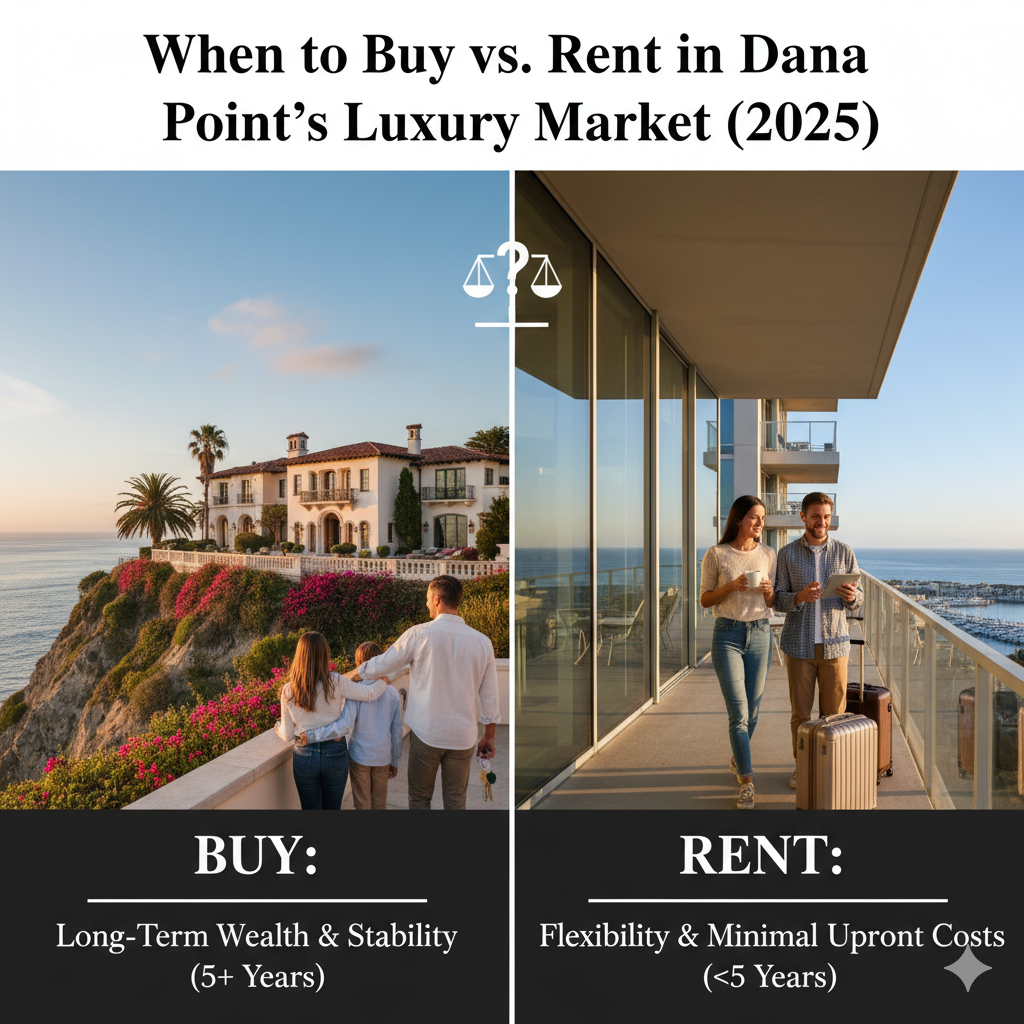
In Dana Point's luxury real estate market, purchasing generally suits buyers planning to stay five or more years and seeking capital appreciation, while renting appeals to those prioritizing flexibility, minimized upfront costs, and shorter-term stays. The decision hinges on investment timeline, available capital, and personal lifestyle preferences within this exclusive coastal enclave.
Should You Buy or Rent in Dana Point's Luxury Real Estate Market?
Dana Point's luxury market presents distinct financial and lifestyle advantages for both buyers and renters. Understanding the current pricing, inventory levels, and market dynamics is essential for making an informed decision aligned with your long-term goals and financial position.
Current Dana Point Luxury Market Snapshot (2025)
Home Purchase Market Conditions
The Dana Point luxury segment commands strong pricing and limited supply. Median luxury home prices range from $1.7 million to $2.2 million, with elite oceanfront properties in Monarch Beach and The Strand commanding $10 million to $20 million or higher. Price per square foot typically falls between $914 and $1,011 for prime properties.
Inventory remains critically tight, with fewer than three months of supply in high-end segments. This scarcity directly supports steady annual appreciation, historically averaging 3 to 6 percent yearly. Over the past year alone, values have climbed by 3 to 6 percent, reflecting sustained demand for coastal luxury real estate.
Ownership entry costs are substantial. Buyers typically need 20 percent down payments—ranging from $300,000 to more than $1 million—plus closing costs. Annual property taxes run 1 percent of assessed value under California's Proposition 13, plus voter-approved local bonds and assessments, typically totaling approximately 1.1 percent in Orange County. Homeowner association fees for gated or amenitized communities add $300 to $1,000+ monthly. Maintenance responsibility and costs fall entirely on the owner.
Luxury Rental Market Conditions
Dana Point's rental market thrives on strong local and seasonal demand. Premium homes with oceanviews command $10,000 to $60,000 monthly, while luxury condos and upscale communities range from $3,000 to $8,000 monthly. Typical properties rent between $5,500 and $6,900 monthly, with ultra-luxury beachfront estates reaching $18,000 to $25,000+ monthly.
Rental demand remains robust for both annual leases and short-term furnished stays, driven by Dana Point's renowned lifestyle, boating culture, and vacation appeal. Importantly, rent-to-value ratios in the luxury segment are relatively low—annual rental income typically represents less than 3 percent of home value—meaning investors prioritize long-term appreciation over immediate cash flow returns.
Buying vs. Renting: Financial Comparison
| Factor | Buying a Luxury Home | Renting a Luxury Home |
|---|---|---|
| Initial Capital Required | 20%+ down payment ($300K–$1M+), closing costs, reserves | Security deposit, first month's rent; minimal upfront |
| Monthly Housing Expense | Mortgage ($9,000–$15,000), property tax (~$1,830), HOA/insurance/maintenance (~$1,500+) | Rent ($5,500–$25,000+ depending on tier) |
| Equity & Wealth Building | Yes—principal paydown plus home appreciation over time | No—all payments benefit landlord |
| Tax Advantages | Mortgage interest deduction, property tax deduction, potential depreciation benefits | None |
| Flexibility & Mobility | Low—best suited for 5+ years; selling carries 5–10% transaction costs | High—30+ days' notice typically required |
| Lifestyle Control | Complete—renovate, customize, create permanent residence | Limited by lease terms and landlord approval |
| Long-Term Wealth Impact | Significant—appreciation, forced savings via mortgage, inflation hedge | Minimal—subject to annual rent increases |
Practical Example: Real Monthly Costs
Purchasing a $2 Million Luxury Home
- Down payment (20%): $400,000
- Estimated monthly mortgage (6% rate): $9,600
- Property tax (1.1% annually): ~\$1,830/month
- HOA, insurance, and maintenance: ~\$1,500+/month
Total estimated monthly cost: $13,000–$14,000+
Renting an Equivalent Luxury Property
- Comparable oceanview homes: $10,000–$18,000+/month
- Ultra-luxury estates: $25,000–$60,000+/month
- Renters avoid maintenance, property tax, and major repairs
While monthly rental costs may appear comparable, renters accumulate zero equity. Buyers, conversely, build wealth through principal paydown and property appreciation while gaining lifestyle stability.
When to Buy in Dana Point's Luxury Market
- Long-Term Residency Plans: 5+ year horizon to recoup transaction costs and benefit from 3–6% historical appreciation.
- Significant Liquid Capital: Down payment, closing costs, and reserves; cash buyers avoid rate sensitivity.
- Desire for Lifestyle Security and Customization: Full control over renovations and environment.
- Wealth-Building Goals: Inflation hedge via appreciation, tax benefits, and principal paydown.
- Preference for Stability Over Mobility: Avoid eviction risk and annual rent increases.
When relocating to Dana Point, buyers with 5+ year horizons typically realize stronger financial outcomes than renters over the same period.
When to Rent in Dana Point's Luxury Market
- Maximum Flexibility Needed: Corporate assignments, possible transfers, or lifestyle experimentation.
- Testing Neighborhoods Before Purchasing: Consider 6–12 months to sample areas from The Strand to Monarch Beach.
- Limited Capital or Alternative Investments: Deploy capital elsewhere while maintaining mobility.
- Short-Term Stays (Under 3–4 Years): Avoid entry/exit transaction costs and timing risk.
- Desire to Avoid Maintenance Responsibility: Turnkey living with landlord-managed repairs.
- Testing Long-Term Residency Appeal: Explore weather, boating lifestyle, and culture without ownership.
Strategic Market Timing and Seasonality
Optimal Buying Windows
Mid-fall through winter (October–February) typically features lower competition and better negotiating conditions. Spring–summer (March–August) tends to favor sellers with higher competition and pricing.
Interest Rate Considerations (2025)
As of October 30, 2025, mortgage rates for 30-year fixed loans average 6.17% and 15-year fixed rates 5.41% (Freddie Mac PMMS). The Federal Reserve reduced its benchmark rate by 25 bps in October 2025, to 3.75–4.0%. Luxury buyers are relatively rate-insensitive, with cash transactions comprising a substantial share of high-end sales.
Inventory and Appreciation Trends
Limited coastal land, ongoing harbor revitalization investments, and consistent global demand support a resilient appreciation environment over the long term.
Investment Property and Rental Income Strategy
Long-Term Rental Income Reality
Annual rental revenue for luxury long-term rentals typically covers 50–80% of gross ownership expenses early on. Owners often accept negative cash flow initially, relying on appreciation as the primary wealth driver.
Vacation Rental Potential
Short-term rentals can generate higher revenue for oceanfront/premium-amenity properties but require active management and compliance with local rules. See: investment property returns and ROI analysis.
Break-Even Timeline
Many luxury purchases break even versus renting after 5–8 years, considering appreciation, tax savings, and transaction costs.
Break-Even Analysis and Ownership Timeline
The 5-Year Threshold
Typical break-even spans 5–8 years. Shorter horizons often favor renting due to high entry/exit costs.
Transaction Costs Reality
Purchasing often incurs 3–5% closing costs; selling involves 5–7% in commissions and related fees—8–12% combined.
Example Analysis
On a $2M home appreciating 3% annually (~$60,000/year), early costs (e.g., $100,000–$150,000 at purchase) mean benefits meaningfully outpace costs only after several years.
Dana Point Luxury Real Estate Market Resilience
Limited coastal land, a $600M harbor revitalization, and steady high-net-worth demand support 3–6% long-term appreciation expectations—compelling for buyers with appropriate horizons.
Explore: Dana Point's best neighborhoods for 2025 and pros and cons of Dana Point living.
Frequently Asked Questions
How long should I plan to stay before buying makes financial sense?
Most analyses show ownership outperforming renting after 5–8 years, depending on conditions and property specifics.
What percentage of my income should luxury home payments represent?
Target total housing costs at 28–30% of gross household income. Many Dana Point luxury homes require $13,000–$14,000+ monthly, implying $500,000+ annual household income for comfortable DTI ratios.
Are luxury vacation rentals in Dana Point profitable?
Premium oceanfront properties can gross $150,000–$300,000+ annually; typical net returns land around 5–12% after expenses and management. See the ROI analysis for details.
Making Your Decision: A Framework
Choose buying if:
- Committed to 5+ years in Dana Point
- Have liquid capital for down payment and reserves
- Value long-term wealth building and inflation protection
- Want full lifestyle control and customization
- Comfortable with ownership responsibilities
Choose renting if:
- Expect relocation within 3–4 years
- Need maximum flexibility
- Want to test neighborhoods first
- Prefer predictable costs and turnkey living
- Don’t want maintenance responsibilities
The optimal decision reflects your financial capacity, timeline, and lifestyle priorities. For personalized guidance, consult an experienced luxury real estate professional familiar with Dana Point.
Official Sources & References
- Freddie Mac Primary Mortgage Market Survey: freddiemac.com/pmms
- Federal Reserve FOMC Statement (Oct 29, 2025): federalreserve.gov
- California Board of Equalization—Property Tax: boe.ca.gov & FAQs
- Dana Point Harbor Revitalization: Official page & FAQs
- City of Dana Point—Community Maps (GIS): danapoint.org
- California Association of REALTORS®—Market Data: car.org
Categories
Recent Posts








REVIEWS